Tree Removal in Trinity: Keep Your Property
Key Takeaways
-
Base Decisions on Safety Risks: Tree care decisions in Trinity should rely on a documented risk assessment by an ISA Certified Arborist rather than guesswork.
-
Know When to Trim vs. Remove: Use tree trimming for localized branch issues like minor deadwood or roof overhangs; choose tree removal when the trunk, roots, or overall stability are compromised.
-
Watch for High-Risk Warning Signs: Immediate evaluation is needed for rapid lean changes, fungal growth (conks) at the trunk base, heaving soil, hollow trunks, or severe root decay.
-
Leverage Florida Tree Permit Exemption (FS 163.045): Florida homeowners can bypass local removal permits, fees, and delays if an ISA Certified Arborist documents that the tree poses an unacceptable risk.
-
Account for HOA and Commercial Rules: The residential state permit exemption does not automatically apply to commercial properties, HOA common areas, multifamily housing, or certain protected trees.
-
Inspect Trees After Storms: Saturated ground and heavy winds in the Tampa Bay area can quickly cause compromised trees to shift, split, or lose root anchorage.
-
Rely on Written Findings and Professional Service: Documented arborist evaluations protect owners legally and financially, ensuring safe execution, emergency hazard clearing, and proper stump removal.
Trees add shade, structure, and value to Trinity properties, but keeping every tree without expert tree care is not always the safest or smartest choice. In many cases, tree trimming or pruning or emergency tree service can correct a limited issue and preserve a healthy canopy. In other cases, tree removal and stump removal are the responsible path because the tree has become a real risk to people, buildings, vehicles, or nearby infrastructure.
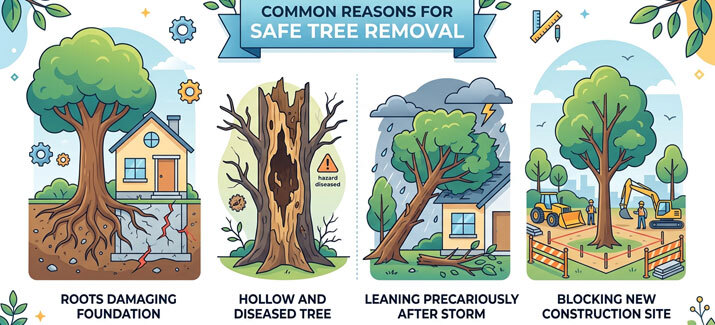
That decision should not rest on guesswork. In Florida, especially across the Tampa Bay area, the strongest case for tree removal or comprehensive tree care is usually a documented safety concern that trimming cannot reasonably fix. When a qualified arborist identifies active structural failure, root decline, or major dead wood, removal shifts from a preference to a practical property-protection step.
Tree removal decisions in Trinity should start with tree risk
Trinity properties often require tree services and landscaping to manage a mix of mature landscapes, storm exposure, saturated soils, and close proximity between trees, structures, and driveways. Those conditions can make defects more serious than they first appear. A tree that looked stable last season may change quickly after heavy rain, wind, lightning, soil disturbance, or nearby construction.
University of Florida IFAS guidance is clear on one point: unhealthy trees can become serious safety hazards, and the best way to judge their condition is to have them evaluated by an ISA Certified Arborist. That matters because visible decline is only part of the picture. Some of the most dangerous failures begin below grade, where roots decay or lose anchorage long before the canopy looks dramatically different.
A sound assessment also helps separate inconvenience from real risk. A tree that drops small twigs or creates too much shade is not in the same category as a tree with a rapidly developing lean, decayed roots, or large dead limbs over a roofline.
Tree risk indicators that can justify tree removal
Some warning signs deserve prompt attention because they are commonly associated with higher failure risk in Florida. UF/IFAS materials point to issues like quick changes in lean, dead branches, cavities near the base, root defects, and signs of decay around the root collar.
When these defects are advanced, a tree risk assessment may show that tree trimming or pruning cannot fix the underlying problem. Cutting back limbs does not restore decayed structural wood, rebuild damaged roots, or correct a trunk that has lost integrity. In those cases, removal can be the more defensible and safer option.
Common red flags include:
- Rapid lean: A tree that begins leaning quickly needs immediate evaluation
- Dead branches: Loose bark, missing bark, or limbs with no foliage or buds can indicate major decline
- Root collar defects: Cavities, swelling, or visible decay at the base may point to structural weakness
- Fungal conks: Mushrooms or conks near the trunk base can signal internal decay or root problems
- Soil upheaving: Lifted or cracked soil around the root zone may suggest root plate movement
- Broken root stubs: Severed or decayed support roots reduce stability during storms
- Hollow trunk: Large interior voids can leave the remaining wood unable to carry the load
- Root rot: Advanced root decay often makes a tree unsafe even if some foliage still appears healthy
In Trinity, these conditions deserve extra attention before hurricane season and after strong storm events. Wind and saturated ground create a demanding test for any compromised tree. If the support roots appear dead, decayed, or missing, an arborist should assess whether the tree poses a significant risk of collapse in strong winds.
When tree trimming or pruning is the better choice
Not every problem points to removal. In many situations, careful tree trimming or pruning can reduce risk, improve clearance, and help preserve a valuable tree. If the issue is limited to a few dead limbs, low overhang, branch interference, or selective pruning, pruning may solve the problem without sacrificing the whole tree.
That is one reason professional evaluation matters. Property owners often assume a large tree needs to come down when the actual fix is selective pruning, structural pruning, or targeted tree trimming in a limited area. The reverse is also true. A tree may look salvageable from a distance, yet show root failure or hidden decay that pruning cannot solve.
Here is a practical side-by-side view:
| Condition | Tree trimming or pruning may help | Tree removal is more likely |
| A few dead limbs in an otherwise healthy canopy | Yes | No |
| Branches overhanging a roof or driveway | Yes, if structure is sound | Only if defects are severe |
| Canopy clearance for visibility or access | Yes | No |
| Rapidly increasing lean | Rarely enough on its own | Often yes after assessment |
| Root rot or advanced root decay | No | Often yes |
| Large trunk cavity or hollowing tied to weakness | Limited value | Often yes |
| Repeated storm breakage with major structural loss | Sometimes, if damage is minor | Yes when integrity is badly reduced |
| More than half the tree significantly damaged | Unlikely | Often yes |
A strict rule of thumb is this: if the main problem involves tree care at the branch level, tree trimming or pruning may be appropriate, but an emergency tree service might be required if the situation poses an immediate risk. If the main problem is in the trunk, root system, stump removal, or overall structural stability, removal becomes much more likely.
Florida permit rules for tree removal on residential and commercial properties
Permit rules are a major part of any tree removal decision, and they are not uniform across all properties. Florida law creates an exception for certain residential removals, but that exception is narrower than many people expect.
Under Florida Statute 163.045, local governments may not require a notice, application, approval, permit, fee, or mitigation for pruning, trimming, or removing a tree on residential property when the owner has documentation from an ISA-certified arborist or a Florida-licensed landscape architect showing the tree presents an unacceptable risk to people or property. The key points are residential property, proper documentation, and an actual safety risk. This is not a blanket pass for removing healthy trees based on preference.
Commercial sites, HOA common areas, multifamily parcels, and some protected-tree situations can follow different rules. Municipal or county ordinances may still require permits, mitigation, or additional review. Tampa’s guidance, while outside Trinity itself, reflects how many local jurisdictions approach this issue: protected trees generally cannot be removed without authorization, and risk claims may need a formal on-site assessment using accepted tree-risk procedures.
Before scheduling tree removal, it helps to sort through a few basics:
- Property type
- County or municipal jurisdiction
- Whether the tree is protected
- Whether the issue is documented as an unacceptable risk
- Whether an HOA or commercial management standard also applies
That is why many property owners start with expert tree care from an arborist and a tree service contractor who can assess the landscaping and identify whether permit handling is needed, along with tree services that may be required. It saves time, reduces confusion, and helps avoid preventable compliance problems.
Why documented arborist findings matter for Trinity tree removal
A tree risk assessment does more than say a tree looks bad. It documents the condition, the defect, the likely failure mode, and the target that could be struck if failure occurs. That gives property owners a record grounded in accepted professional practice rather than opinion.
For a residential property in Florida, that documentation can be central to the legal path for removing a dangerous tree. For commercial properties, it can support permit applications, insurance records, maintenance planning, and board or ownership decisions. In both cases, written findings create a stronger basis for action.
A quality evaluation often looks at:
- Lean history: Whether the angle is longstanding or recently changed
- Target exposure: The people, vehicles, buildings, utilities, or access points within range
- Root condition: Root collar decay, fungal conks, severed roots, or soil movement
- Trunk integrity: Cavities, cracks, seams, decay pockets, or hollow sections
- Crown condition: Deadwood, failed limbs, sparse foliage, or imbalanced weight distribution
That level of detail helps answer the most practical question on any Trinity property: can tree trimming or pruning reduce the risk to an acceptable level, or is the tree no longer a reasonable candidate for retention?
Tree removal after storms and sudden tree changes in Tampa Bay
Florida storms often accelerate tree problems that had been developing quietly for years. A tree may survive one season with a weak root system, then shift after the next round of wind and saturated soil. In Trinity, that means post-storm inspections are not just for obviously fallen trees. Trees that remain standing can still be compromised.
Rapid change is the signal to take seriously. A fresh lean, exposed roots, newly cracked soil, split scaffolding limbs, or a large limb tear-out can mean the structure has already changed in a meaningful way. Waiting for visible collapse is not a sound risk strategy.
Storm-related warning signs worth acting on quickly include:
- fresh lean after wind
- heaving soil near the base
- hanging or broken limbs
- cracks in the trunk or major unions
- mushrooms or conks appearing at the base
- exposed or torn roots
In some cases, emergency tree service can remove immediate hazards while a broader tree care plan is made. In others, the safest response is full removal before the next weather event raises the stakes.
Tree removal planning for residential, HOA, and commercial Trinity properties
The decision process, including considerations of landscaping, often looks different depending on who owns the property and how the site is used. A homeowner may focus on roof safety and driveway access. An HOA may need to weigh resident safety, common-area exposure, and recordkeeping. A commercial property owner may need to account for customer parking, building entrances, service routes, and liability management.
Still, the core standard stays fairly steady: removal is easiest to justify when a qualified arborist documents active safety risk and tree trimming or pruning will not reasonably reduce that risk. That is the point where removal becomes less about preference and more about duty of care.
A practical action sequence can help keep the process organized:
- Inspect the tree after storms, visible decline, or sudden lean changes, and consider hiring tree services for a professional evaluation.
- Arrange an arborist assessment if the tree shows structural or root-related warning signs.
- Determine whether pruning can reduce the hazard or whether removal is the safer option.
- Confirm permit requirements based on property type and local jurisdiction.
- Schedule the work with a licensed and insured tree service equipped for the site conditions, including professional stump removal.
For Trinity property owners, engaging expert tree service supports better decisions and fewer surprises. It also preserves good trees when pruning is enough and removes unsafe trees when the evidence points clearly in that direction.
FAQs About Tree Removal in Trinity
Why is professional tree removal important for my property in Trinity?
Professional tree removal ensures safety, prevents property damage, and addresses potential hazards from diseased or unstable trees. Experts use specialized equipment and techniques to remove trees efficiently and safely.
When should I consider tree removal?
You should consider tree removal if a tree is dead, diseased, leaning dangerously, or causing structural damage to your property. Trees that interfere with power lines or have extensive root problems may also need removal.
What is the difference between tree removal and tree trimming or pruning?
Tree removal involves completely taking down a tree, including its trunk and major branches. Tree trimming or pruning, on the other hand, focuses on selectively removing branches to improve the tree’s health, appearance, and safety.
How often should trees be trimmed or pruned?
Most trees benefit from trimming or pruning every 1-3 years, depending on the species and their growth rate. Regular maintenance helps promote healthy growth and reduces the risk of falling branches.
Is a permit required for tree removal in Trinity?
Permit requirements vary by location and the size or species of the tree. It’s best to consult with local authorities or a professional tree service to determine if a permit is needed before proceeding.
What are the risks of DIY tree removal or trimming?
DIY tree removal or trimming can be dangerous due to the risk of falling branches, improper equipment use, and potential property damage. Hiring professionals ensures the job is done safely and correctly.
Can tree trimming help prevent the need for removal?
Yes, regular trimming and pruning can improve a tree’s health and structure, potentially extending its lifespan and reducing the likelihood of removal due to disease or instability.
What happens to the tree after removal?
After removal, the tree can be cut into firewood, chipped for mulch, or hauled away. Stump grinding or removal is often available as an additional service.
How do I choose the right tree removal service in Trinity?
Look for a licensed, insured, and experienced company with positive reviews. Ask about their safety practices, equipment, and whether they provide both removal and trimming/pruning services.
What are the signs that a tree needs professional attention?
Warning signs include dead or hanging branches, visible decay, cracks in the trunk, leaning, root damage, or sudden loss of leaves. If you notice any of these, contact a professional for an assessment.
What smart property owners ask before approving tree work
The best tree decisions usually come from asking sharper questions, not from moving faster. If a contractor recommends removal right away, it is reasonable to ask why trimming will not solve the issue. If someone suggests pruning on a tree with major root decline, it is also reasonable to ask how that would address the actual failure risk.
A few direct questions can improve the outcome:
- Is the main defect in the limbs, trunk, or roots?
- Has the tree’s lean changed recently?
- Are there signs of root collar decay or fungal conks?
- Does the tree pose an unacceptable risk to people or property?
- Is this a case where residential Florida documentation affects permit requirements?
Those questions create a stronger path for action, whether the answer is targeted tree trimming, structural pruning, or full tree removal. On many Trinity properties, the right choice is not the most aggressive one. It is the one supported by condition, risk, and sound local guidance.
