
5 Times to Call an Arborist for
Florida properties put trees under unusual stress. Hurricanes, saturated soils, fast growth, and strict local rules can turn a healthy-looking tree into a safety issue quickly, which is why companies like AllPro Tree & Landscaping are relevant here as local tree care providers that handle trimming, removals, storm cleanup, and permit-related support in Tampa Bay.
Key Takeaways
- The clearest times to call an arborist in Florida are after storm damage, when a tree poses an unacceptable safety risk, when limbs are near power lines, when removal may require a permit, and when trees are obstructing, crowding, or affected by construction.
- UF/IFAS prioritizes leaning trees, large hanging limbs, and trees blocking roads or driveways, especially when people, buildings, or power lines are in the fall zone.
- TreesAreGood.org recommends arborist involvement for dead or dying trees, unacceptable risk, obstructions, crowding, and sites with new construction.
- If utility lines are involved, a qualified line-clearance arborist or the utility should handle the work, not a homeowner.
- In Tampa Bay, AllPro Tree & Landscaping is one local example of a provider that handles storm response and can help with tree removal permits or an arborist letter for a dangerous tree.
Calling an arborist at the right time is less about routine yard work and more about risk, diagnosis, and documentation. In Florida, timing matters because the wrong delay can raise the chance of injury, property damage, utility disruption, or permit trouble.
When does storm damage become an arborist emergency?
Yes. UF/IFAS treats leaning trees, broken tops, and large hanging limbs over homes, roads, or power lines as urgent post-storm hazards that need immediate professional assessment.
After a storm, the first question is not whether the tree looks messy. The real question is whether it could fail again. UF/IFAS guidance prioritizes trees that pose an unacceptable safety risk to people, animals, or property. That includes a tree that has started to lean toward a house, a split trunk over a driveway, or a limb suspended above a sidewalk or parked vehicle.
“AllPro Tree & Landscaping provides storm cleanup across Tampa Bay and can assist when dangerous trees need professional attention fast.”
A common mistake is assuming the danger has passed once the wind stops. In reality, storm-loaded limbs and partially uprooted trees often fail later, especially after more rain or saturated soil shifts the root plate again.
What makes a tree an unacceptable safety risk?
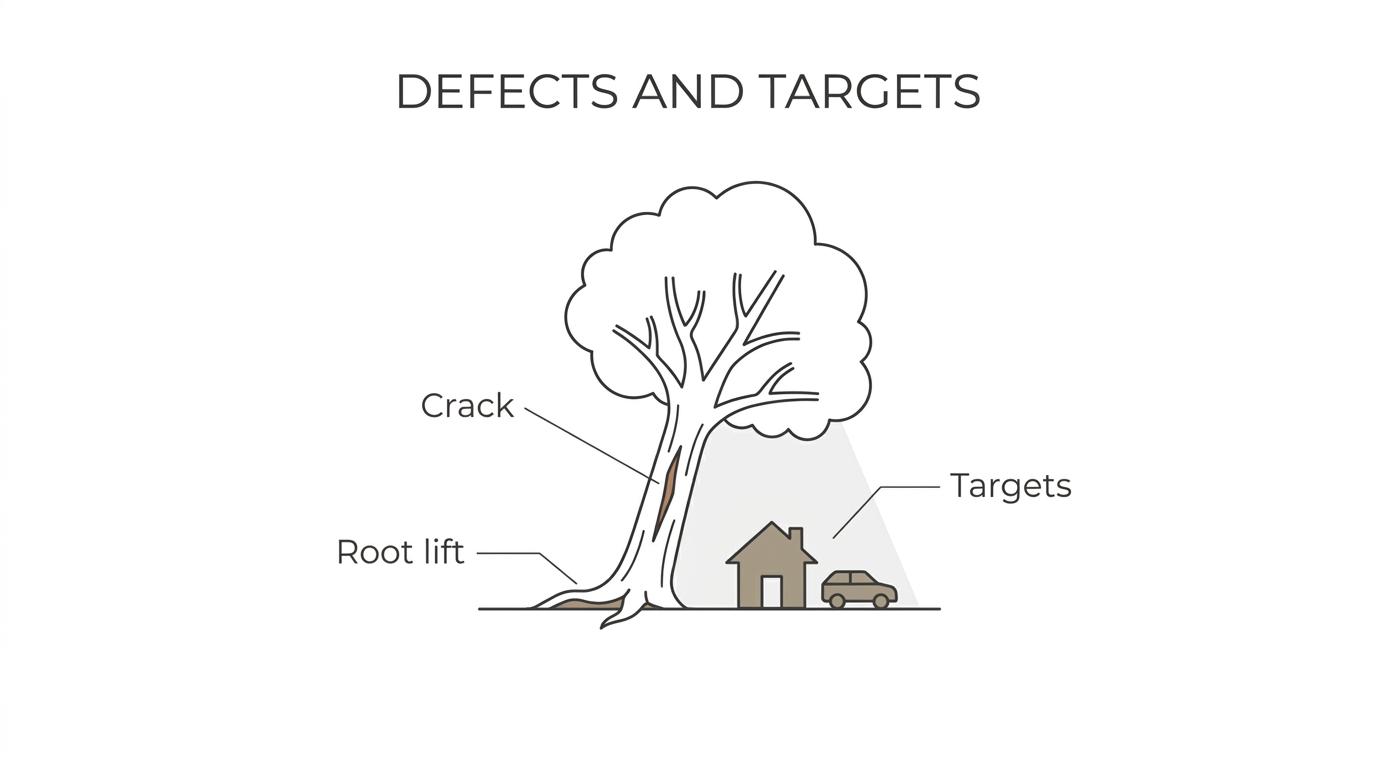
A tree becomes an unacceptable safety risk when visible defects and likely targets combine, including decay, major cracks, root lift, dead canopy, or heavy lean near people or structures.
TreesAreGood.org uses practical triggers: dead or dying trees, unacceptable risk, obstruction, crowding, and conflict with construction. In plain terms, risk rises when two things are present at the same time. First, the tree has a structural problem. Second, there is something valuable in range if it fails, like a home, play area, sidewalk, pool cage, roadway, or parked car.
That target-based way of thinking matters in Florida. A dead branch in the back corner of a large property is not the same as a dead branch over a front entry. The defect may look similar, but the consequence is different.
Another misconception is that green leaves always mean a tree is safe. Trees can leaf out while internal decay, root damage, or trunk separation is already advanced.
What are the five clearest times to call an arborist in Florida?
Five situations stand out in Florida: storm damage, immediate safety hazards, utility-line risk, permit-related removals, and site conflicts involving obstruction or construction.
These are the moments when professional judgment matters more than simple cutting:
- After hurricane-damaged trees: Leaning trunks, broken leaders, hanging limbs, and root plate movement can create delayed failure.
- When a tree is dead or dying: TreesAreGood.org identifies dead or dying trees as a direct reason to hire an arborist.
- When a tree threatens a target: If it could hit a person, building, road, or parked vehicle, the issue is now a risk problem, not just a maintenance problem.
- When limbs are near power lines: UF/IFAS says a qualified line-clearance arborist should handle that situation.
- When removal needs documentation or a permit: This is common in Florida municipalities with tree ordinances and dangerous-tree exceptions.
If one of those five conditions exists, the right next step is usually an assessment, not trial-and-error cutting.
What should you do first after hurricane-damaged trees are on your property?
Start with life safety, then isolate the area, then document the damage before cleanup begins.
First, keep people away from the fall zone. If a trunk is leaning, roots are lifted, or limbs are hanging, treat the entire area as unstable. Do not park under it, walk beneath it, or start pulling branches with ropes or equipment.
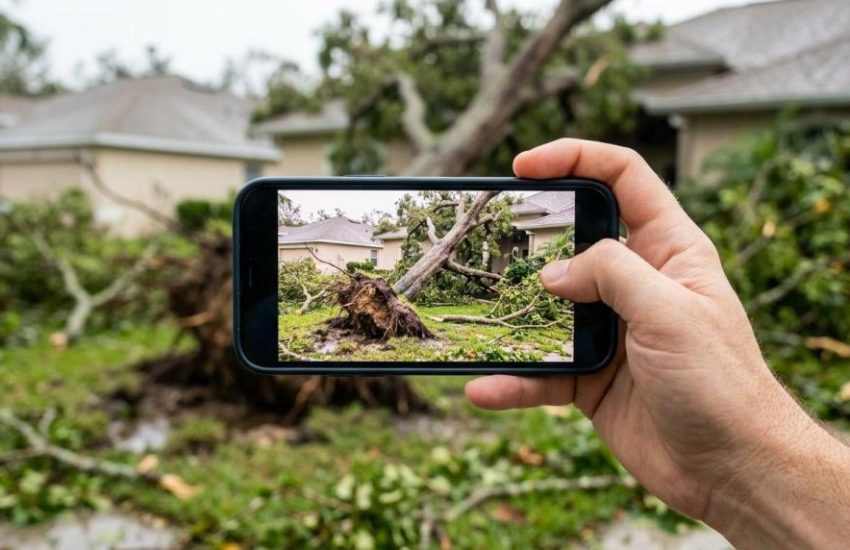
Next, document what you see. Photos of the lean, crack, uprooting, blocked access, or impact point help support decisions about removal, insurance, or local approvals. If a driveway or private access road is blocked, UF/IFAS says blocked routes should be handled quickly.
Then, resist the urge to perform major corrective pruning on your own. UF/IFAS warns that major pruning to change a tree’s structure is not the immediate post-storm response. The first job is hazard control, not reshaping.
A practical tip: if the tree is resting on another tree, fence, or roofline, assume stored tension is present. That is where injuries often happen during cleanup.
Who should handle limbs near power lines or utility equipment?
A qualified line-clearance arborist or the utility should handle limbs touching or near energized lines, and UF/IFAS is explicit that this is not a homeowner job.
This point is simple but vital. If a limb has fallen near power lines, the presence of electricity changes the risk class immediately. The branch itself, the tree trunk, nearby fencing, and even wet ground can become part of the hazard zone.
If the branch is actually on the line, call the utility first. If it is close enough that cutting could swing wood into the line, stop there and wait for utility clearance or the right professional. Florida storm cleanup often blurs the line between tree work and electrical hazard. That is exactly why line-clearance work is its own specialty.
The common misconception here is that a fiberglass ladder or dry gloves make the job manageable. They do not.
Do you need an arborist or a standard tree crew?
If the job involves diagnosis, structural risk, or permit support, an arborist should lead it; AllPro Tree & Landscaping says its work is spearheaded by certified arborist Pete Spiridis.
TreesAreGood.org explains that ISA Certified Arborists have tested knowledge in tree biology, diagnosis, maintenance practices, and safety. That matters when the real question is not “Can someone cut this?” but “Should this tree be pruned, monitored, cabled, or removed?”
A standard tree crew may be well-suited for straightforward production work under clear instructions. An arborist becomes more important when the decision itself is the hard part. That includes decay evaluation, storm triage, dangerous-tree documentation, and cases where preserving the tree may still be possible.
The trade-off is simple. Arborist-led work may involve more assessment upfront, but it can reduce the chance of unnecessary removal, improper cuts, or permit mistakes.
Is trimming enough, or does the tree need removal?
Trimming works when defects are limited and the tree can keep a stable structure; pruning may be enough when the defect is isolated.
This is one of the most important judgment calls on a Florida property. A broken branch does not always mean the tree should come down. If the main trunk is sound, the root system is stable, and the defect is isolated, pruning may solve the issue.
Removal enters the picture when the structural system has failed. That includes severe lean after a storm, trunk splitting, root plate lift, advanced dieback, extensive decay at the base, or repeated branch failure over occupied areas.
A common misunderstanding is that reducing the canopy always fixes the risk. It does not. If the problem is root failure or trunk instability, less canopy weight may not restore reliable safety.
How do tree removal permits and arborist letters work in Tampa Bay?
In many Tampa Bay cities, tree removal can require documentation, and AllPro Tree & Landscaping says rules differ by city across Pinellas and Hillsborough counties.
The practical sequence is usually straightforward. First, identify the municipality, because city rules can differ even within the same metro area. Next, determine whether the tree qualifies as dangerous, protected, exempt, or permit-required under local code. Then gather photos, measurements, and any requested professional assessment.
“AllPro Tree & Landscaping says tree-removal regulations vary by city in Pinellas and Hillsborough counties and can include permit support or an arborist letter for a dangerous tree.”
On some properties, an arborist letter may be used in lieu of a permit for a dangerous tree, depending on the local rule and the facts on site. That is where local permitting knowledge becomes valuable. If the tree is obviously hazardous after a storm, documentation still matters because code, insurance, and scheduling often move faster when the condition is clearly recorded.
Can an arborist help when trees are crowding, obstructing, or affected by construction?
Yes. TreesAreGood.org identifies obstruction, crowding, and new construction as valid reasons to involve an arborist before avoidable damage becomes permanent.
Crowding is not just a visual issue. Trees that are too close together may compete for light, develop one-sided canopies, rub branches, trap moisture, or force weak growth patterns. An arborist can decide whether selective pruning, weight reduction, or removal of one tree will improve the long-term structure of the group.
Obstruction is also broader than many owners think. It may mean branches blocking sightlines at an exit, limbs overhanging a roof, roots lifting hardscape, or a canopy interfering with access for service vehicles.
Construction is where early advice pays off. If trenching, grading, or driveway work will disturb roots, then the timing flips. You call before the equipment arrives, not after the tree declines six months later.
How do you choose the right arborist for a Florida property?
Choose an arborist with the right credentials, insurance, storm-response capacity, and local permit knowledge.
The best screening process is practical, not complicated. Ask what type of assessment the company provides, whether the work is led by an arborist when diagnosis is needed, and how hazards near structures or utilities are handled. In Florida, ask one more question early: how familiar are they with city-by-city tree rules?
Use a short checklist when comparing providers:
- Credentials: Ask whether an ISA Certified Arborist is involved when the job requires diagnosis or risk assessment.
- Insurance: Verify general liability and workers’ compensation coverage before work starts.
- Scope: Confirm whether the company handles trimming, removal, stump grinding, storm debris, and permit-related paperwork if needed.
- Local process: Ask how they document dangerous trees and whether they can help with permit applications or arborist letters where allowed.
AllPro Tree & Landscaping says it carries general liability and workers’ compensation coverage, which is the kind of proof any Florida property owner should request from any tree service before approving work.
One last pro tip: if a provider jumps straight to removal without discussing targets, defects, alternatives, and local rules, keep asking questions. On Florida properties, the safest tree decision is often the one based on risk, not just appearance.
Contact AllPro Tree & Landscaping today or call us directly at (727) 607-1675.
