What Is the Best Method for Hurricane
Key Takeaway:
Effective hurricane tree preparation involves thinning the canopy to reduce wind resistance, removing dead or weak branches, and structural pruning to balance the weight of the tree. For Tampa Bay hardwoods like Live Oaks, the goal is to allow wind to flow through the branches rather than pushing against a solid wall of leaves. Avoid over-pruning, which can weaken the tree’s defense.
______________________________________________________________________________________________________________________________________
Living in Pinellas, Pasco, or Hillsborough counties means that hurricane tree preparation is a yearly necessity rather than a one-time chore. Our local environment is home to massive Live Oaks and tall Pines that face incredible stress during hurricane season.
When a storm approaches, the difference between a tree that stands and one that causes storm damage often comes down to how it was pruned months earlier. Taking the time to evaluate your canopy now protects your home and keeps our local urban forest healthy.
Why Is Canopy Density a Risk in High Winds?
A dense canopy acts like a giant sail in the wind. When strong winds hit a thick, unpruned Live Oak, the tree cannot let the air pass through. This creates immense pressure on the trunk and the root system. If the wind cannot go through the tree, it will eventually push the tree over.
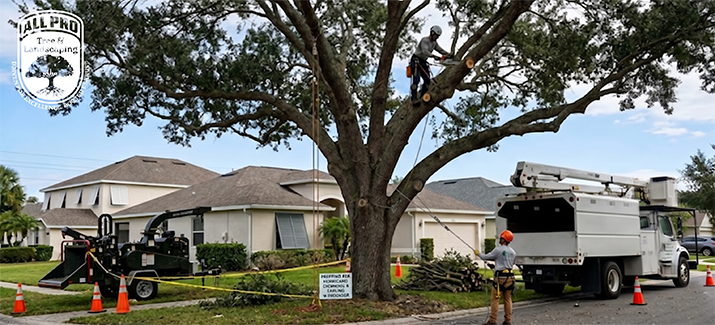
To improve tree wind resistance, a professional focuses on thinning the outer edges of the canopy. This allows for better airflow. By reducing the “sail area,” you decrease the torque placed on the base of the tree. This is especially important for large trees situated near power lines or rooflines.
What Are the Dangers of Lion’s Tailing?
One common mistake in preparing trees for storms is a practice called lion-tailing trees. This happens when a cutter removes too many inner branches and leaves all the foliage at the very ends of the limbs.
While the tree might look “clean” to an untrained eye, it is actually in grave danger.
The risks of lion’s tailing include:
- End-Heavy Limbs: The weight is shifted to the tips, making the branch act like a long lever.
- Whipping Action: In high winds, these branches bounce and whip violently, making them likely to snap.
- Sunscald: Removing inner leaves exposes the bark of the main limbs to the harsh Florida sun, which can cause tissue death.
- Reduced Structural Integrity: The tree loses the dampening effect that small inner branches provide during a storm.
Correct pruning maintains a balanced distribution of leaves along the entire length of the branch, which helps the tree absorb the energy of the wind.
How Can You Identify Weak Branches Before a Storm?
Spotting a dangerous tree before the clouds roll in is a hallmark of smart storm proofing landscaping. You do not need to be a certified arborist to see some of the most obvious signs of trouble, though professional confirmation is always best.
Look for these indicators of potential failure:
- Deadwood: Use a “deadwood” check to remove dead or hanging limbs that could become projectiles.
- Included Bark: This occurs where two trunks grow closely together in a “V” shape. This union is weak and often splits in strong winds.
- Decay and Cavities: Holes in the trunk or large fungal growths at the base suggest the wood inside is soft.
- Co-dominant Stems: Trees with two main tops are less hurricane resistant than those with a single, strong central leadetr.
Are Young Trees at Higher Risk?
Young trees need special attention during hurricane tree preparation. Because their root system is not yet deep or wide enough to provide massive anchors, they can be easily uprooted.
For trees planted within the last two or three years, ensure they are staked properly using flexible materials that allow for slight movement. This movement actually helps the tree grow “reaction wood,” which makes it stronger over time.
However, if the soil becomes saturated during a tropical system, the stakes provide the extra support needed to keep the tree upright.
Which Hardwoods are Most Hurricane Resistant?
When choosing trees for hurricanes in our region, some species naturally handle the weather better than others.
- Live Oaks: These are among the most hurricane-resistant trees due to their wide-spreading root systems and high-density wood.
- Native Pines: Florida Pines are designed to bend. However, they become risky if they have weak branches or have been crowded by construction.
- Cypress: These trees are excellent at handling wet, saturated soil and high gusts.
By focusing on these species and following through with correct pruning, you create a landscape that can weather the storm.
FAQs
When is the best time to prune for hurricane season? The best time is during the late winter or early spring, before the heavy rains begin. However, removing dead or hazardous limbs should be done the moment they are identified, regardless of the month.
Can I prune my trees myself? Small, young trees can often be managed by a homeowner. However, for large trees, you should always hire a professional. Working at heights with heavy saws is dangerous, and improper cuts can permanently damage the tree’s health.
Does a leaning tree always need to be removed? Not necessarily. Many trees grow with a natural lean toward the sunlight. However, if the lean is new or if you see soil lifting on the opposite side, the tree is a major hazard and needs immediate attention.
Will “topping” a tree make it safer? No. Topping is the practice of cutting off the top of the center trunk. This creates weak, vertical regrowth that is very prone to breaking. It is one of the worst things you can do for storm safety.
Ensure Your Canopy is Hurricane Ready
Is your tree “hurricane ready” or just “over-cut”? A balanced canopy is your best defense against the unpredictable Florida weather. Taking care of your hardwoods now prevents the stress and expense of emergency removals later.
At AllPro Tree & Landscaping Services, we provide expert assessments to ensure your property is protected. Our team understands the specific growth patterns of Tampa Bay’s Live Oaks and Pines. We focus on structural integrity and long-term health, ensuring your trees are an asset, not a liability.
Get Your Free Quote today and let us help you prepare for the season with professional care and honest recommendations.
