Tree Care: How Often Should Florida Trees
Key Takeaways
- Regular tree inspections and tree care are essential for maintaining healthy, safe landscapes in Florida’s unique climate.
- Florida trees should be professionally inspected at least once a year, and after major storms or hurricanes, to ensure that inspection services catch any potential issues early.
- Early detection of disease, pest infestations, or structural issues can prevent costly damage and enhance tree longevity.
- ISA certified arborists provide essential services by using specialized knowledge to identify hidden risks and identify potential problems, recommending proactive tree care solutions.
- Homeowners and property managers play a vital role by monitoring trees on your property for visible signs of stress or damage between professional inspections.
- Investing in routine tree care services reduces liability, protects property, and supports Florida’s vibrant ecosystem.
Florida trees live in a setting that is both generous and demanding, where careful landscaping and proper tree care play a crucial role. Warm temperatures, long growing seasons, saturated soils, hurricanes, summer thunderstorms, and rapid root growth all shape how trees age and how risk develops over time.
That is why tree risk inspection in Florida is not a one-time task. A tree can look fine one season and show meaningful structural change after heavy rain, trenching, wind exposure, or a root disturbance. For homeowners, HOAs, and commercial property owners, the better question is not whether to inspect trees, but how often the inspection should happen based on age, condition, and site use.
Florida tree inspection frequency recommendations for proper tree care
The short answer is this: many Florida trees should be reviewed on a periodic basis, and higher-risk trees should be inspected more often. Guidance from UF/IFAS Extension and the International Society of Arboriculture supports regular risk review, with at least annual assessment in many settings and more immediate follow-up when warning signs appear.
For aging trees in otherwise stable condition, UF/IFAS guidance supports visual inspection and inspection by a certified arborist about every two years. That is a useful baseline, especially for mature shade trees that have grown large enough to affect roofs, driveways, pedestrian areas, parking, or neighboring property.
A shorter cycle makes sense when the consequences of failure are higher. If a tree is near a home, pool enclosure, playground, road, or busy common area, annual professional review is often the wiser standard. Some guidance for hazardous tree management supports at least annual assessment where people or property are common targets.
Side-by-side Florida tree scenarios showing lower-risk trees needing periodic checks, mature trees near structures needing yearly review, and damaged or unstable trees needing immediate inspection.
A storm-prone region changes the rhythm too. In places like Tampa Bay, the interval between inspections should tighten after tropical weather, repeated wind events, flooding, or construction activity near roots.
| Tree situation | Suggested inspection timing | Why timing changes |
| Young, healthy tree in a low-target area | Periodic visual checks, professional review if conditions change | Lower consequence if failure occurs |
| Mature tree near a house, driveway, sidewalk, or common area | About once a year | Higher target use and larger canopy weight |
| Aging tree with no obvious defect | About every 2 years | Age alone raises the need for periodic review |
| Tree with prior storm damage, heavy end weight, or pruning history | Every 6 to 12 months, depending on condition | Existing weaknesses can worsen faster |
| Tree with cracks, cavities, sudden lean, or suspected root damage | Immediate inspection | These can point to active failure risk |
| Tree after major storm, flooding, trenching, or grade change | Prompt post-storm inspection | Root plate and canopy stability may have changed |
That table is a planning tool, not a substitute for site-based judgment. One live oak may remain stable for years, while another of the same age may need urgent attention because of internal decay, codominant stems, or recent root loss.
Why Florida trees need regular risk inspections
Florida’s weather is part of the answer, but not the whole answer. Tree risk develops from structure, biology, and site conditions working together. A healthy-looking canopy does not always mean a stable tree.
Highlighted quote card with the line: A healthy-looking canopy does not always mean a stable tree.
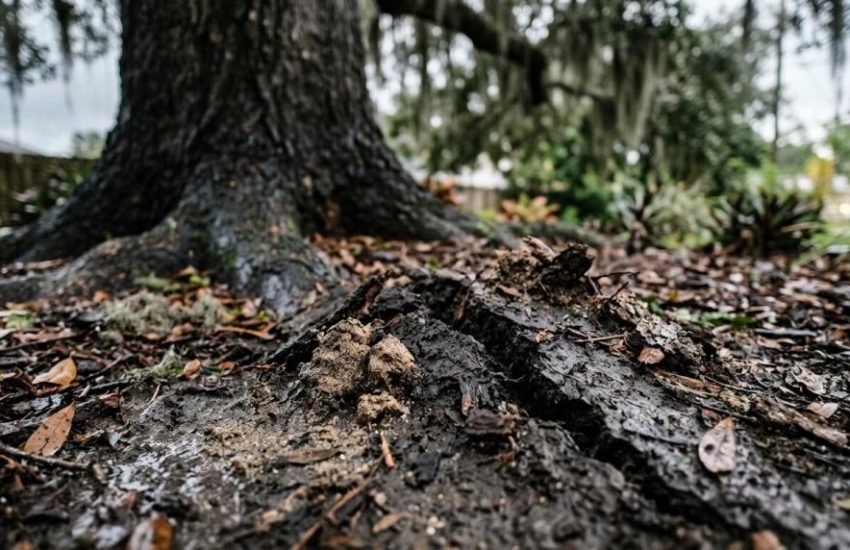
Root issues are a good example. A tree can hold green leaves and still have major root damage from excavation, utility work, excess fill soil, repeated mower injury, drainage problems, inadequate watering, or compaction. When roots are compromised, the root flare and root plate may tell the story before the canopy does.
This is one reason periodic inspections matter. Problems in branches, trunk tissue, and the root zone often start small. If identified early, pruning, structural pruning, soil care, cabling in select cases, or a change in maintenance practices may reduce risk and extend tree life.
A regular inspection program also supports better budgeting. Property managers and HOA boards can schedule corrective work before storm season instead of reacting during it.
Signs a Florida tree needs immediate risk inspection
Routine scheduling is helpful, but certain warning signs move a tree out of the “watch it” category and into “call now.” UF/IFAS and ISA materials are clear on this point: visible structural defects and suspected root problems should prompt examination by a qualified arborist.
If a tree suddenly starts to lean, that is not something to monitor casually. A fresh lean, heaving soil, or cracking around the base can indicate root collar and root plate failure in progress. Major deadwood over a structure also deserves prompt attention.
Common red flags include:
- Sudden lean
- Fresh soil lifting near the base
- Large dead limbs
- Deep trunk cracks
- Cavities in major scaffold unions
- Mushrooms, pest infestations, or decay indicators near the root zone or root collar
- Split codominant stems
- Exposed or damaged roots
- Recent lightning or storm breakage
Some warning signs are subtle. Repeated branch drop, thinning in one side of the canopy, bark separating from the trunk, or a history of topping can all change how a tree carries load in wind.
When any of these signs appear, the goal is not guesswork. It is prompt assessment by ISA Certified Arborists, ideally one with Tree Risk Assessment Qualification, or TRAQ, when the tree’s condition is complex.
What an ISA Certified Arborist looks for in a tree risk inspection
A qualified inspection is more than a quick glance upward; it involves meticulous tree care, including visual inspection, to ensure safety and health. It considers the whole tree, the site, and the likely targets below or nearby. In practical terms, that means evaluating whether a defect is present, how likely failure may be, what the tree could strike, and what options exist to reduce risk.
The arborist may inspect from the top down and the ground up at the same time, studying branch architecture, trunk form, wound closure, root flare visibility, soil grade, and signs of movement. They also consider species traits, age class, past pruning, and storm exposure.
Typical inspection points include:
- Canopy structure: deadwood, unbalanced limb weight, storm breakage, weak branch attachments
- Trunk condition: cavities, seams, cracks, decay pockets, internal decay, included bark
- Stem architecture: codominant stems, old topping cuts, poor taper, past failure points
- Root zone: damaged roots, buried root flare, girdling roots, excavation effects
- Site conditions: drainage problems, compacted soil, watering practices, restricted rooting area, landscaping features, target occupancy
That process helps identify potential cosmetic defects from structural concerns. A hollow-sounding section of trunk, for example, may or may not be severe depending on extent, location, remaining sound wood, and the tree’s load pattern.
In some cases, the outcome is straightforward pruning. In others, the best step may be monitoring at shorter intervals. When risk reaches an unacceptable level, removal may be the responsible option.
How property use changes tree inspection schedules
Not every tree needs the same timeline, because not every tree stands over the same kind of target, or benefits from the same services. A tree in an open back corner of a large property with several trees on your property presents a different level of concern than a similar tree over a nursery school pickup lane.
This is where risk, condition, and tree care meet. The condition of the tree matters, but the occupancy below it matters too. High-use areas justify a shorter inspection interval even when defects appear modest.
For many Florida properties, these patterns are useful:
- Single-family homes: Annual review for mature trees close to the house, plus checks after storms
- HOA common areas: Annual inspections are often the baseline because sidewalks, roads, and amenities increase target use
- Commercial sites: Frequent review may be needed around parking lots, building entries, signage, and service lanes
- Vacant or low-use zones: Periodic review may be adequate when targets are limited
Trees also change categories over time. A tree that was once low-risk can become a higher-priority inspection item after a patio expansion, driveway widening, irrigation work, or repeated storm pruning.
That is one reason many property owners benefit from a written tree inventory. It creates a record of species, size, condition, target area, and recommended follow-up date. Instead of reacting to the loudest problem first, the site can be managed with a clearer order of priority.
Storm season and post-storm tree inspections in Florida
Storm season deserves its own calendar. Even when a tree looked sound in spring, summer wind and saturated soils can shift the picture quickly.
A post-storm inspection is valuable after hurricanes, tropical storms, strong thunderstorm outflows, or prolonged flooding. Trees may not fail right away. They can be weakened first, then give way weeks later when the next weather event arrives.
After a storm, property owners should watch for a few specific changes:
- New lean or twisted canopy
- Broken tops
- Hanging limbs
- Split trunk unions
- Cracked soil at the base
- Uplifted root area or changes in the root collar
- Fresh bark loss on main stems
This is also when poor pruning history often shows up. Trees that were topped, lion-tailed, or stripped of interior growth may have weaker regrowth and poorer load distribution. By contrast, trees that received proper structural pruning earlier in life often perform better in wind.
Simple homeowner checks between arborist visits
Professional inspection services are the backbone of risk management, yet brief owner walkarounds, combined with visual inspection, still matter as part of effective tree care because they help identify potential issues early. They help catch visible changes early, which is often the difference between routine corrective work and an urgent removal.
A practical approach to tree care is to look over the trees on your property a few times a year, especially before storm season, after major storms, and after any digging or hardscape work near roots. Spend a minute at the base, another on the trunk, and another looking at major limbs from different angles.
Keep these checks simple:
- Look for change, not perfection
- Compare this season to last season
- Photograph anything new
- Note work that happened near roots
- Schedule help if something looks different
What should homeowners avoid? Climbing to inspect, cutting large limbs without training, and assuming green leaves equal safety. Many serious defects, such as internal decay, begin in the root system or inside branch unions where foliage tells only part of the story.
Frequently Asked Questions (FAQs)
How often should I have my Florida trees inspected?
Trees in Florida should be inspected by ISA certified arborists at least once a year, and after severe weather events such as hurricanes or tropical storms, to ensure tree services address any immediate concerns.
What are the signs that my tree needs immediate attention?
Look for dead or hanging branches, cracks in the trunk, leaning trees, fungal growth, pest infestations, or sudden loss of leaves. These may indicate underlying issues that require prompt professional evaluation.
Can I inspect my trees myself?
While homeowners can look for obvious signs of damage or disease, a certified arborist has the expertise to identify hidden risks and provide comprehensive tree care recommendations.
Why are tree inspections important in Florida?
Florida’s climate and frequent storms increase the risk of tree damage. Regular inspections help prevent property damage, personal injury, and costly emergency removals.
What should I do if I suspect a tree is hazardous?
Contact a certified arborist immediately to assess the risk and determine the best course of action for safety and tree health.
Does insurance cover tree damage in Florida?
Coverage varies by policy. Regular inspections and documented tree care may help with insurance claims if damage occurs. Always check with your insurance provider for specific details.
Building a practical tree inspection schedule for Florida properties
A workable schedule usually starts with three dates: a routine annual review, a storm-season check, and a follow-up whenever visible defects appear. Mature or aging trees may need a shorter cycle, especially if they are close to structures or known targets.
For many properties, that means a late winter or spring inspection before the strongest storms begin, then a second check after major weather events. Aging trees that are stable may stay on a roughly two-year arborist cycle if the site is low-risk, but that interval should shrink when concerns develop.
The most useful mindset is consistency. Tree risk changes gradually at times and suddenly at others. A periodic, qualified review helps property owners make calm, informed decisions about tree services instead of rushed ones after a limb falls or a trunk splits.
When Florida trees are inspected on the right schedule, care becomes more proactive, storm preparation becomes more realistic, and the landscaping keeps more of its value, shade, and safety at the same time.
