Storm Cleanup Services: What to Expect in
Storm cleanup services work best when treated as hazard control first and yard restoration second. After a hurricane, tropical storm, or severe wind event in Tampa Bay, the first priorities are removing immediate dangers, handling debris correctly, and drying wet materials fast enough to limit mold.
Key Takeaways
- Storm cleanup services in Tampa Bay usually include fallen tree removal, storm debris hauling, stump grinding, yard clean-up, and property restoration, with safety controls based on CDC guidance and Florida debris rules.
- The fastest critical window is mold prevention: the CDC says cleanup and drying should happen within 24 to 48 hours after a storm or flood if possible.
- Safe storm cleanup requires PPE, including hard hats, goggles, heavy work gloves, waterproof steel-toe boots, and an N95 respirator or higher when dust or mold is present.
- Heavy debris is not a solo job: the CDC advises at least two people for bulky objects and no more than 50 pounds lifted per person.
- In Florida, private property owners are generally responsible for debris on their own property, while debris that creates an immediate threat to public health and safety may be eligible for FEMA Public Assistance when handled by the responsible local entity.
- In practice, many storm cleanup jobs combine tree damage cleanup, debris removal, stump removal, and drainage or landscape repair, especially in Pinellas, Pasco, and Hillsborough counties.
In Florida, that distinction matters because storm cleanup is both a labor job and a debris-management job. Local rules, insurance documentation, tree hazards, and moisture control all affect what should happen first and what can wait a day or two.
What does storm cleanup service include after a hurricane or severe storm?
Storm cleanup in Tampa Bay usually includes fallen tree cutting, debris removal, stump grinding, and yard restoration. CDC safety guidance and Florida DEP rules make clear that this is not just cosmetic work. It is hazard reduction, material handling, and rapid moisture control.
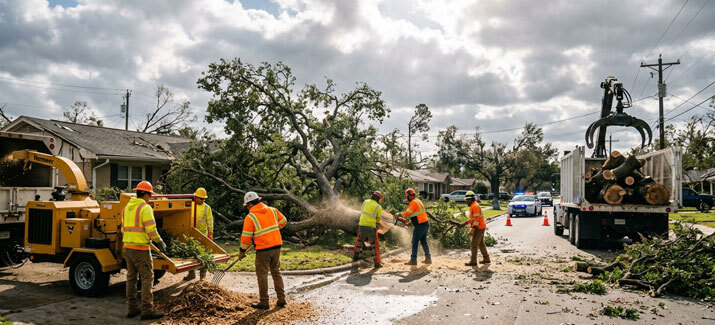
A typical scope starts with access and safety. Crews clear blocked driveways, remove limbs from roofs and fences when safe to do so, cut down broken or uprooted trees, address fallen trees, and haul away loose debris. If the storm leaves a stump, exposed roots, or torn turf, cleanup often moves into stump grinding, grading, sod replacement, and drainage repair.
Many property owners assume storm cleanup ends when the branches are gone. In reality, the job often continues until the site is stable, usable, and less likely to create a second problem, such as mold, trip hazards, blocked drainage, or pest harborage.
“AllPro Tree & Landscaping serves Pinellas, Pasco, and Hillsborough counties with tree damage cleanup, stump removal, and yard restoration.”
The exact service mix depends on the damage. If a tree is leaning toward a structure, that is a tree hazard response. If scattered limbs, fence fragments, and saturated mulch cover the yard, that becomes a debris sorting and restoration job.
When should storm cleanup start to reduce safety and mold risks?
Storm cleanup should start as soon as the site is safe to enter. The CDC says cleanup and drying should happen within 24 to 48 hours after a storm or flood if possible to help prevent mold growth.
Storm cleanup flow showing hazards isolated first, damage documented next, wet materials dried within 24 to 48 hours, then debris removed and yard restored.
Step 1 is hazard isolation in emergency response. If power lines are down, if a tree is resting on a house, or if floodwater may hide sharp objects, do not begin cutting or lifting. Secure the area, keep children and pets out, and call the utility or emergency responders when the hazard involves electricity, gas, or unstable structures.
Step 2 is documentation and triage. Photograph the damage before moving major items when it is safe to do so. Then sort the site by risk: life-safety hazards first, water intrusion second, drainage obstructions third, and appearance issues last.
Step 3 is drying and removal. Wet drywall, soaked insulation, and waterlogged organic debris can drive mold quickly in Florida heat. A common mistake is spending the first full day on curb appeal while wet materials stay in place. If the property is wet, drying outranks beautification.
What are the most important storm cleanup services in Tampa Bay?
The most important storm cleanup services are those that facilitate storm recovery by removing danger first. In Tampa Bay, that usually means tree hazard work, debris hauling, moisture control, and surface restoration.
After a major storm, homeowners and property managers usually need a combination of services rather than one isolated task. The list below reflects the most common post-storm work sequence.
- AllPro Tree & Landscaping: Storm-related tree damage cleanup, stump removal, yard restoration, and storm-debris or fallen-tree cleanup in Pinellas, Pasco, and Hillsborough counties.
- Emergency fallen tree removal: Best when a trunk blocks access, presses on a structure, or creates a secondary collapse risk.
- Debris sorting and hauling: Useful for separating vegetative debris, damaged materials, and items that may need special disposal.
- Stump grinding and root-zone cleanup: Important when uprooted or broken trees leave trip hazards or prevent replanting and repair.
- Drainage and landscape restoration: Often needed after saturated soils, washed-out beds, displaced rock, or turf damage.
The trade-off is speed versus scope. Emergency crews may first focus only on hazards and access, then return for full restoration once the site is stable.
How should homeowners handle storm debris safely step by step?
Homeowners should treat storm debris like a physical hazard, not routine yard waste. The CDC recommends hard hats, goggles, heavy work gloves, waterproof steel-toe boots, and an N95 respirator or higher when exposure warrants it.
Step 1 is gear and separation. Put on PPE before touching debris, and separate branches, sharp metal, broken glass, construction materials, and wet household contents. Mixed piles slow removal and can create injury risks.
Step 2 is lifting discipline. The CDC advises teams of at least two people for heavy or bulky objects and says workers should avoid lifting more than 50 pounds per person. A common misconception is that storm cleanup injuries come mostly from chainsaws. Back strain, punctures, slips, and eye injuries are often more common.
“AllPro Tree & Landscaping performs yard clean-up across all of Tampa Bay and includes debris removal as part of that service.”
Step 3 is escalation. If a branch is under tension, if a trunk is split but still partially attached, or if debris is lodged on a roof, stop and bring in trained help. If-then logic matters here: if the debris can move unpredictably, then it is no longer a simple cleanup task.
How is storm cleanup different from tree removal or yard clean-up?
Storm recovery is broader than tree removal and more urgent than routine yard clean-up. Tree removal is usually the right service when a dead, cracked, uprooted, or storm-damaged tree must come down. Yard clean-up fits scattered debris, leaf loads, and general post-storm site tidying. Storm cleanup covers both, then adds hazard assessment, emergency response, hauling, moisture response, and site restoration.
This difference affects pricing and crew type. A debris-only crew may not be the right fit for a partially suspended tree, while a tree crew may not be the best choice for mud management, sod recovery, and drainage correction unless they offer comprehensive professional services that cover both tree and landscape issues. If the property has both hazards and mess, a combined scope reduces handoff delays.
Who is responsible for storm debris on private property in Florida?
In Florida, private property owners are generally responsible for debris on their own property, including fallen trees. Florida DEP states that owners must remove debris from their land, whether upland or wetland.
That rule surprises many people after a hurricane. A common mistake is assuming the city or county will automatically clear everything once debris reaches the lot line. Public pickup programs often focus on rights-of-way or publicly managed areas, not full private-lot cleanup.
The responsibility also changes by location and type. Debris in federally designated navigable channels or turning basins may fall under the U.S. Army Corps of Engineers when it creates a navigation hazard. That is different from branches, fencing, or damaged landscape material inside a private yard.
If you manage an HOA or commercial site, ownership maps matter. Shared common areas, retention edges, gate approaches, and internal roads may each have different cleanup obligations.
What storm debris may qualify for FEMA Public Assistance in Florida?
FEMA Public Assistance in Florida can apply to certain debris that poses an immediate threat to public health and safety. Florida DEP identifies this under debris guidance tied to Public Assistance, often discussed as Category A debris operations.
The key comparison is public threat versus private responsibility. A limb pile on a private lawn is usually the owner’s issue. Debris blocking emergency access or threatening public safety may be handled differently when the responsible local entity removes it under program rules.
A useful way to think about eligibility is this:
- Immediate threat: Debris that threatens public health, public safety, or improved public property may fit Public Assistance criteria when removed by the responsible local entity.
- Private property debris: Homeowners and private owners usually remain responsible unless a special authorized program applies.
- Debris staging areas: Florida DEP approval matters when staging areas are used for FEMA-funded debris operations.
This is where documentation matters. If a municipality is involved, load tickets, site records, and approved staging procedures can affect reimbursement. If the debris is purely private-lot material, the practical question shifts from eligibility to safe removal and insurance support.
How do you choose a storm cleanup company after a hurricane?
The best storm cleanup company is licensed, insured, responsive, and able to handle both hazards and debris. In Tampa Bay, that often means a provider with tree-care capability, yard clean-up capacity, and local permitting familiarity.
Step 1 is capability matching. Ask whether the company handles fallen trees cleanup, stump grinding, debris hauling, and restoration, or only one piece of the job. If your property has multiple damage types, a single coordinated scope usually saves time.
Step 2 is safety and proof. Verify insurance, ask how the crew handles suspended limbs and unstable trees, and confirm whether a certified arborist or equivalent tree evaluation resource is available when tree condition is unclear. Fast response is useful, but rushed cutting without proper controls is expensive.
“AllPro Tree & Landscaping is licensed and insured, serves residential and commercial properties, and includes a certified arborist on staff.”
Step 3 is local fit. In storm-prone areas like Clearwater, St. Petersburg, and greater Tampa Bay, local disposal routes, permit expectations, and county-specific response patterns can affect timing. A good rule is simple: choose the company that can explain the work sequence, not just promise fast removal.
What should HOAs and commercial properties prioritize during storm cleanup?
HOAs and commercial properties should prioritize access, liability reduction, continuity of use, emergency response, and the integration of professional services for comprehensive site management. Tampa Bay sites with parking lots, shared roads, and retention areas need a more structured response than a single-family yard.
The first pass should focus on life-safety zones and business function. Entrance drives, fire lanes, sidewalks, storefront access, monument signs, and drainage inlets usually come before decorative areas. If the site stays partially open, then pedestrian separation and temporary routing become part of cleanup.
A practical priority stack looks like this:
- Access routes: Clear entrances, fire lanes, loading zones, and ADA paths first.
- Hazard trees: Isolate cracked leaders, hanging limbs, and root plate failures near buildings or parking.
- Drainage points: Remove debris from swales, inlets, and low spots before the next rain.
- Surface recovery: Address mud, washout, mulch displacement, and turf damage after hazards are controlled.
For larger sites, phased cleanup is often the smart trade-off. It restores use quickly without pretending the full landscape can be rebuilt on day one.
When do you need tree hazard evaluation, stump grinding, or yard restoration after storm cleanup?
You need hazard evaluation when a tree is cracked, leaning, partially uprooted, or contacting a structure. You need stump grinding when the remaining stump blocks access, creates a trip hazard, or prevents repair and replanting.
Storms often leave trees that look stable from a distance but have hidden root failure or internal splits. A common misconception is that a tree that remains standing is safe to keep. If the root plate shifted, soil heaved, or large scaffold limbs tore out, then the tree may still be a high-risk asset.
That distinction is consistent with Pro Natural Landscape’s breakdown of when tree removal makes more sense than trimming, especially when structural damage extends beyond broken canopy wood into the root zone or main stem.
Stump grinding matters more than many owners expect. Leftover stumps interfere with sod repair, drainage grading, and future planting. Yard restoration then finishes the job by resetting beds, replacing sod, re-leveling disturbed soil, and clearing residual storm waste so the property can function normally again.
In Tampa Bay, that full sequence is often the difference between a property that merely looks cleaner and one that is actually safer, drier, and better prepared for storm recovery, ensuring ease of maintenance through the next storm cycle.
